

Can MCP Solve the Last Mile Problem of Data?
The missing link between enterprise data and users

We’ve been swimming in data for nearly two decades. Terabytes turned to petabytes. Our ML models improved. Big Tech figured out how to turn big data into big profits.
But for most enterprises? Dashboards, reports, and lots of spreadsheets. The revolution never reached the frontlines.
The problem is not the data, but getting it to people when they need it and how they need it to make better decisions or automate steps of a workflow. That’s the last mile problem of data.
Right now, bridging the last mile requires building custom applications and workflows. That’s expensive and error-prone.
How AI Can Solve the Last Mile Problem of Data
Imagine an agent that can understand what a user needs and pull in the relevant information and analysis without hunting around dashboards and clicking through reports. Fully customized to the situation at hand. And fully interactive with the ability to drill in and explore.
What this could look like:
A warehouse manager asking, “Where should I reallocate inventory today?” and getting an instant answer powered by the latest demand signals, which they can refine based on worker availability.
A sales rep asking, “Which leads are most likely to convert this week?” and receiving a live-ranked list based on current product usage and engagement data, which they explore based on personal expertise and current news.
A physician querying, “Is this lab result an anomaly?” and seeing patient-specific benchmarks pulled in from across a structured medical database, which they can correlate with medical research and prior visit notes.
With recent advances in Large Language Models (LLMs) it has become surprisingly easy to build AI systems that can understand what a user needs based on their questions and context. LLMs like ChatGPT already do a formidable job being data concierges on public information. But they don’t have enterprise context.
The missing link is between LLMs and data. How can the AI access pertinent information accurately and safely within an organization?
That’s where MCP comes in. The Model Context Protocol (MCP) is an emerging standard that defines how AI systems retrieve external data and execute actions via tools. Think of it as the API layer between the AI’s reasoning engine and external data systems.
Why This Matters
The biggest limitation in most enterprise data initiatives isn’t the data, it’s the delivery. We already know how to collect, clean, and enrich data. We’ve spent two decades refining the upstream data systems: data lakes, ETL pipelines, governance layers.
What we are lacking is the ability to simply operationalize data in a way that is personalized, real-time, and contextual. “Simple” is key. Having to build a custom application or dashboard for every data delivery is too expensive and does not scale. It’s why enterprise internal tools have a bad reputation. They are inflexible, hard to use, and costly to maintain.
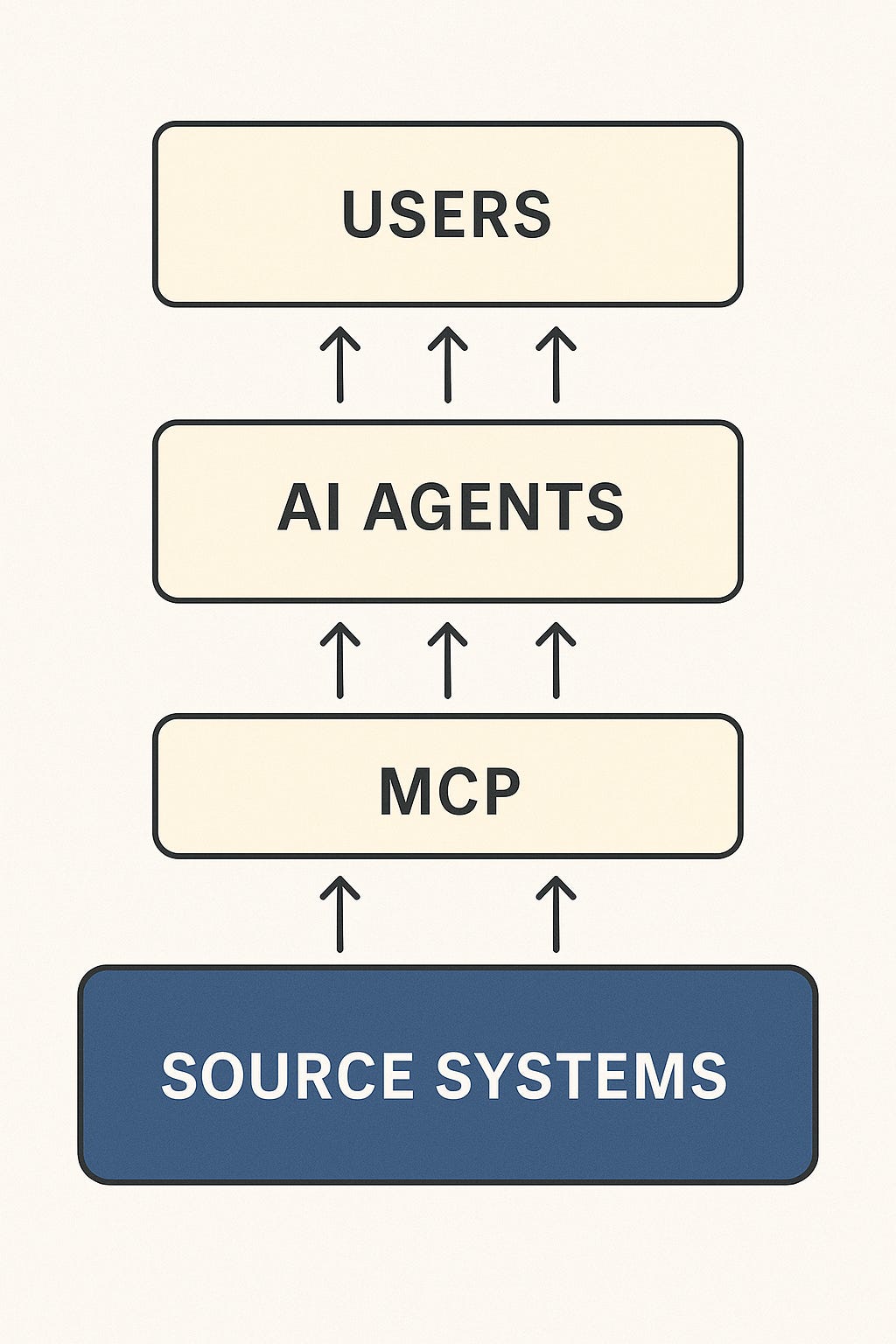
With MCP we get closer to a world where data delivery can be standardized across an organization and users can personalize their access to the unique needs of their work environment.
MCP has the potential to link enterprise data infrastructure with decision makers and workflows through AI mediated access, thereby enabling data-driven transformation.
The challenge ahead is real: enterprises will need to build secure, accurate, and maintainable MCP interfaces that leverage their existing infrastructure.
But if we get this right, it’s a shot at finally delivering on the promise of data-driven transformation.